
What Your Gut is Hiding: How Hidden Overgrowths Are Steering Your Health Imagine sitting down…
Brain Peptides Are Everywhere. Here’s What’s Actually Worth Knowing.

In the last two years, brain peptides have gone from obscure research molecules to one of the biggest trends in health and biohacking.
People are using them for focus, for anxiety, for burnout. Some are trying to prevent cognitive decline. Others are hoping to slow or even reverse it.
And depending on who you listen to, they’re either the future of brain health or they’re expensive, useless, and potentially risky hype.
So which is it?
That’s exactly what I want to walk through here. No hype. No fear. Just what the science actually says and what I’ve seen in practice.
📺 Watch: Brain Peptides Are Everywhere, But Do They Work?
Why This Conversation Is Happening Now

More than 50 million people worldwide currently live with dementia. By 2050, that number is expected to triple. If you condense that into the United States alone, you’re talking about something close to half the population affected. That’s not a small public health footnote. That’s a defining challenge of our time.
Right now, one in nine adults over 65 in the United States has full-blown Alzheimer’s disease. And mild cognitive impairment, the stage that often comes before dementia, affects roughly 20% of adults over 65.
Here’s what’s important to understand though. Research suggests that up to 50% of dementia risk may be influenced by lifestyle and metabolic factors. My clinical experience actually puts that number closer to 95%. But the core point stands: cognitive decline is not entirely inevitable. And that realization, for a lot of people, creates a very powerful psychological shift.
At the same time, traditional medicine has very few tools to offer. The existing drugs approved for dementia are either minimally effective or carry significant risks. So people start searching. And when fear meets a rapidly growing industry, trends spread fast. The brain health and nootropics market is expected to exceed 15 billion dollars within the next decade. Social media accelerates all of it.
Brain peptides sit exactly at that intersection of fear, hope, and emerging science.
The context matters: When a legitimate health concern meets an industry growing that fast, it becomes very hard to separate signal from noise. That’s not a reason to dismiss the field. It’s a reason to approach it carefully and with good information.
What Peptides Actually Are
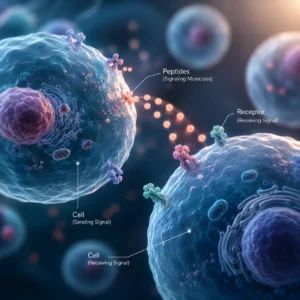
Before we can evaluate whether brain peptides work, it helps to understand what peptides actually are.
Peptides are short chains of amino acids. Your body produces thousands of them every day, possibly tens of thousands. Scientists have identified more than 7,000 peptides in the human body that act as signaling molecules. They are how your cells communicate with each other.
Think of peptides as text messages between cells. They tell cells when to repair, when to grow, when to reduce inflammation, when to create it, when to adapt to stress, and even when to form new connections.
Insulin is a peptide. Many modern medications are peptide based. There are already more than 80 peptide drugs approved worldwide, with hundreds more in the developmental pipeline.
Peptides are not fringe science. That matters, and it should be genuinely reassuring.
What is new is the growing interest among everyday people in peptides that interact specifically with the brain.
Your brain is roughly 2% of your total body weight but uses about 20% of your total energy. It is constantly trying to repair itself. It is not a static organ. It is always adapting in real time. That is exactly why researchers became interested in peptides that may support the brain’s natural repair signals.
The Three Forces Working Against Your Brain as You Age

The brain faces three major forces of aging that researchers are actively trying to address.
The first is neuroinflammation. Chronic, quiet inflammation that disrupts signaling and gradually degrades brain function over time.
The second is mitochondrial decline. After the age of 40, mitochondrial function tends to decline by roughly 10% per decade, or about 1% per year. For an average 70-year-old, that math adds up to a 70% decline in cellular energy production. Think about how that would feel across every system in your body, but especially in the most energy-hungry organ you have.
The third is reduced neuroplasticity. The brain’s ability to form new connections, adapt to stress, and recover from damage gradually diminishes without the right inputs and conditions to support it.
Brain volume itself shrinks by about 5% per decade after age 40. These are not small numbers. And they represent the reason this research exists in the first place.
The Most Important Distinction Most People Miss
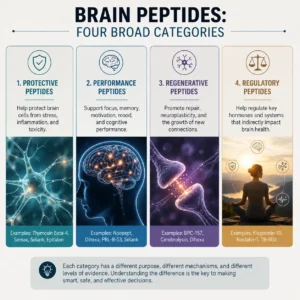
Here is where the internet creates the most confusion and where I want to be especially clear.
Brain peptides are not one thing. They are not a single category with a single effect and a single risk profile. And when people lump them all together online, it produces exactly the kind of noise that makes it impossible to think clearly about any of them.
I organize brain peptides into four broad functional categories.
The first is focus and performance peptides. These are explored for motivation, attention, and mental clarity.
The second is stress and anxiety peptides. These are studied for calming the nervous system and building emotional resilience.
The third is recovery and repair peptides. These are researched in the context of brain injury, burnout, and neuroinflammation.
The fourth is neurodegeneration and aging peptides. These are the ones being studied most seriously in the context of cognitive decline and dementia risk.
When all four of these get discussed as if they are the same thing, some people conclude they are miracle cures and others conclude the entire field is hype. Neither is accurate.
The category matters as much as the peptide itself. A peptide studied for acute stress recovery is a fundamentally different tool than one studied for long-term neuroprotection. Treating them as interchangeable is one of the most common mistakes people make.
Do They Actually Work?

My honest answer is nuanced. And I’d rather give you a nuanced answer than a clean one that isn’t actually true.
Some of the most well-known brain peptides have been studied since the 1980s with decades of clinical use, mostly in Europe, Asia, and Russia specifically. Others are still in early research because the field is constantly discovering new molecules. The evidence quality varies widely depending on the peptide and the condition being studied.
Brain peptides as a category are not a miracle. But they are also not snake oil. This is a real and growing area of neuroscience surrounded by genuine complexity and a significant amount of social media noise. The honest position is somewhere in between the extremes, and that’s where I try to stay.
The most important question most people skip: Effectiveness tends to dominate the conversation. But the more foundational question, especially when it comes to the brain, is safety. Your brain contains somewhere between 80 and 90 billion neurons forming trillions of connections. Before asking whether something works, it’s worth asking what the risks are, who should avoid it, and what the most common mistakes look like. That’s exactly what I’ll cover in part two.
What’s Coming Next
This is part one of a three-part series on brain peptides.
Part two covers safety, risks, and the biggest mistakes people make when experimenting with brain peptides. This is the part most people skip. It’s the part that matters most.
Part three I’ll leave as a reason to stay tuned.
If this topic matters to you or to someone in your life, subscribe so you don’t miss what’s coming.
Curious What’s Blocking Your Vitality?
Take the free RoVive Assessment (3 to 5 minutes) and discover:
- What’s draining your energy, focus, or resilience
- Your number one roadblock to feeling your best
- A personalized next step plus immediate FREE video guidance
Zero cost. Easy. No pressure. Just clarity.
Work With Dr. Yoshi Rahm
If you’re ready for a thoughtful, individualized approach to your brain health and want long term clarity over quick fixes:
📩 Email: Support@RoViveMethod.com
Who this is for: People who want to understand what’s actually happening in the brain health space, without the hype pulling them in one direction or the fear pulling them in the other. Clarity first. Always.
Medical Disclaimer
𝖳𝗁𝗂𝗌 𝖼𝗈𝗇𝗍𝖾𝗇𝗍 𝗂𝗌 𝖿𝗈𝗋 𝖾𝖽𝗎𝖼𝖺𝗍𝗂𝗈𝗇𝖺𝗅 𝖺𝗇𝖽 𝗂𝗇𝖿𝗈𝗋𝗆𝖺𝗍𝗂𝗈𝗇𝖺𝗅 𝗉𝗎𝗋𝗉𝗈𝗌𝖾𝗌 𝗈𝗇𝗅𝗒. 𝖨𝗍 𝗂𝗌 𝗇𝗈𝗍 𝗆𝖾𝖽𝗂𝖼𝖺𝗅 𝖺𝖽𝗏𝗂𝖼𝖾, 𝖽𝗂𝖺𝗀𝗇𝗈𝗌𝗂𝗌, 𝗈𝗋 𝗍𝗋𝖾𝖺𝗍𝗆𝖾𝗇𝗍. 𝖵𝗂𝖾𝗐𝗂𝗇𝗀 𝗍𝗁𝗂𝗌 𝖼𝗈𝗇𝗍𝖾𝗇𝗍 𝖽𝗈𝖾𝗌 𝗇𝗈𝗍 𝖾𝗌𝗍𝖺𝖻𝗅𝗂𝗌𝗁 𝖺 𝖽𝗈𝖼𝗍𝗈𝗋–𝗉𝖺𝗍𝗂𝖾𝗇𝗍 𝗋𝖾𝗅𝖺𝗍𝗂𝗈𝗇𝗌𝗁𝗂𝗉 𝗐𝗂𝗍𝗁 𝖣𝗋. 𝖸𝗈𝗌𝗁𝗂 𝖱𝖺𝗁𝗆, 𝖣𝖮, 𝗈𝗋 𝖱𝗈𝖵𝗂𝗏𝖾, 𝖯𝖢, 𝗈𝗋 𝖺𝗇𝗒 𝖺𝖿𝖿𝗂𝗅𝗂𝖺𝗍𝖾𝖽 𝖾𝗇𝗍𝗂𝗍𝗒. 𝖬𝖾𝖽𝗂𝖼𝖺𝗅 𝖽𝖾𝖼𝗂𝗌𝗂𝗈𝗇𝗌 𝗌𝗁𝗈𝗎𝗅𝖽 𝖻𝖾 𝗆𝖺𝖽𝖾 𝗐𝗂𝗍𝗁 𝗒𝗈𝗎𝗋 𝗈𝗐𝗇 𝗅𝗂𝖼𝖾𝗇𝗌𝖾𝖽 𝗁𝖾𝖺𝗅𝗍𝗁𝖼𝖺𝗋𝖾 𝗉𝗋𝗈𝖿𝖾𝗌𝗌𝗂𝗈𝗇𝖺𝗅, 𝗐𝗁𝗈 𝖼𝖺𝗇 𝖺𝗌𝗌𝖾𝗌𝗌 𝗒𝗈𝗎𝗋 𝗂𝗇𝖽𝗂𝗏𝗂𝖽𝗎𝖺𝗅 𝗁𝗂𝗌𝗍𝗈𝗋𝗒, 𝖼𝗈𝗇𝖽𝗂𝗍𝗂𝗈𝗇𝗌, 𝖺𝗇𝖽 𝗇𝖾𝖾𝖽𝗌. 𝖣𝗈 𝗇𝗈𝗍 𝖽𝖾𝗅𝖺𝗒, 𝖽𝗂𝗌𝗋𝖾𝗀𝖺𝗋𝖽, 𝗈𝗋 𝗌𝗍𝗈𝗉 𝗆𝖾𝖽𝗂𝖼𝖺𝗅 𝖼𝖺𝗋𝖾 𝖻𝖺𝗌𝖾𝖽 𝗈𝗇 𝗍𝗁𝗂𝗌 𝖼𝗈𝗇𝗍𝖾𝗇𝗍. 𝖨𝖿 𝗒𝗈𝗎 𝖺𝗋𝖾 𝖾𝗑𝗉𝖾𝗋𝗂𝖾𝗇𝖼𝗂𝗇𝗀 𝖺 𝗆𝖾𝖽𝗂𝖼𝖺𝗅 𝖾𝗆𝖾𝗋𝗀𝖾𝗇𝖼𝗒, 𝖼𝗈𝗇𝗍𝖺𝖼𝗍 𝖾𝗆𝖾𝗋𝗀𝖾𝗇𝖼𝗒 𝗌𝖾𝗋𝗏𝗂𝖼𝖾𝗌 𝗂𝗆𝗆𝖾𝖽𝗂𝖺𝗍𝖾𝗅𝗒.
Related Posts